
(Case Study)
VUI Pill Tracker
An early voice-first design exploration for medication adherence — built as an Alexa Skill in 2018. The conversational-design practice underneath every AI agent and chatbot engagement I run today.
“The most important part of designing for VUI is understanding how people actually request something — their intent, and the many ways a single person can phrase it. Mapping that surface area is the work.”
The challenge
In 2017, voice was not yet a category. Amazon Echo was three years old, Alexa Skills were a developer curiosity, and “conversational design” wasn’t a discipline anyone hired for. The teams treating voice as serious product surface mostly didn’t exist yet.
Medication adherence, meanwhile, was already a multi-billion-dollar problem. Patients were missing doses and refilling late, and the existing solutions all required the same thing the patient was already failing at: remembering to interact with a screen.
What does a medication reminder look like if you don’t have to look at it? If you can just ask, and be answered, in the same room where you live?
“If users can’t understand how to use your app, they won’t stay long enough to learn it. That’s true everywhere, but voice makes it unforgivable.”
I built this as a hands-on exploration of voice-first design for healthcare adherence, before there was a playbook. The goal wasn’t to ship a commercial product. It was to learn, by doing, what makes a conversational interface actually usable when there’s no screen to fall back on.
I started where voice forces you to start: with the conversation, not the device. How does a person ask about their medication out loud? What are the ten ways someone might phrase “did I take my pill?” What does the skill say when it doesn’t know?
I wrote the directed dialog prompts, mapped every intent, utterance, and slot, and drew the conversation tree by hand before any prototype existed. Then I prototyped in SaySpring and tested with real people. Watching their faces when the skill said the wrong thing was the entire education.
Alongside this voice work, I was concurrently designing chat and text-based conversational interfaces. The same principles carry across modalities. Voice was simply the most unforgiving version, which made it the best teacher.
(Process)
The walk-through
The prototype in motion
A short walkthrough of the VUI Pill Tracker prototype: setting a daily reminder, querying status, and confirming a dose, all by voice. Recorded in 2018 against the SaySpring prototype. Pre-mainstream voice, pre-LLM, pre-agentic anything. The conversational-design instincts on display — modeling intent, designing for repair, never leaving the user without an option — are the same instincts I bring to every AI and conversational engagement today.
Swipe or tap arrows to navigateUse ← → keys to navigate
Selected outcomes
A working VUI prototype, in 2018
Concept, dialog tree, intents and utterances, prototype, and live user testing — completed before voice design was a discipline anyone was hiring for. Built to learn the medium, not to ship a product.
Conversational-design fluency that carries forward
The same principles — user request / system response, repair patterns, always reminding the user what’s possible — now underpin every AI agent, chatbot, and conversational interface engagement I work on. Voice was the strictest teacher.
Hands-on at the frontier of an emerging modality
Alexa Skills hit their first major adoption inflection in 2017–2018. Designing in that window meant working through ambiguity — no patterns, no playbooks, no precedent.
Healthcare-specific voice design, before it was a category
Medication adherence was an obvious unmet need; whether voice could meaningfully serve it was not. The exploration mapped both the promise and the limits of voice for healthcare — lessons that remain directly relevant to AI-driven patient support today.
The reason this case study still matters in 2026 is not the Alexa Skill itself. The skill was a learning vehicle. The reason it matters is what doing it taught me: conversational interfaces — voice, chat, and now AI agents — share a single underlying design discipline.
Map the intent before you map the interface. Design the repair before you design the success state. Never leave the user without a next move. Treat what the system says as carefully as you treat what it does.
Every AI agent and chatbot I help a pharma or healthcare team scope today gets the same questions I asked of this Alexa Skill in 2018. I've been doing this work and building for new systems all along. The modality changes; the work doesn't.
Working on a conversational interface, an AI agent, or a chatbot in healthcare?
Related work
Continue reading
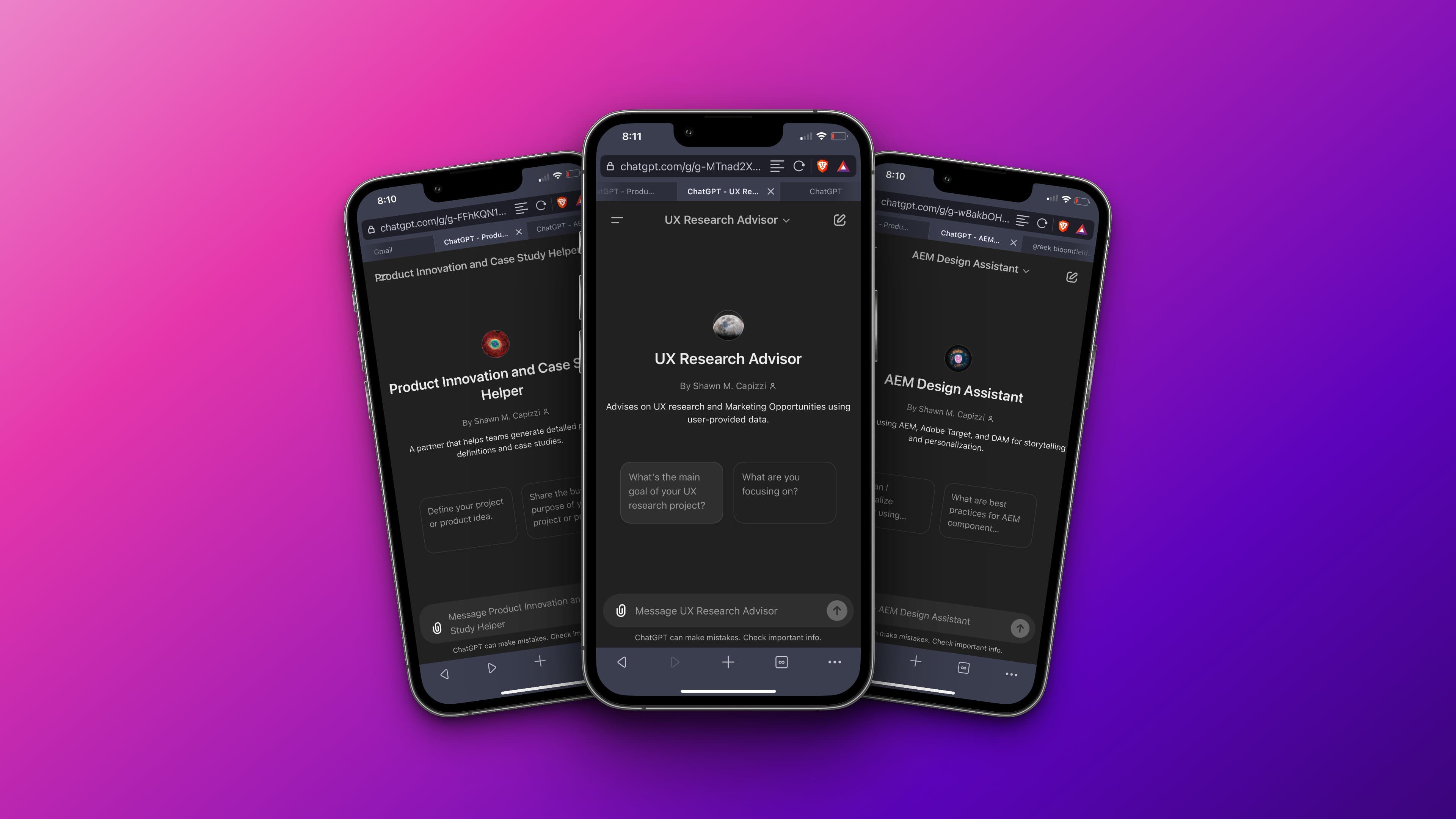
Solo · AI Native Design Lab
Building an AI-native product design lab
Working AI-augmented prototypes, Custom GPTs, and a vendor-agnostic AI advisory practice grounded in hands-on building.

Multi-Brand · 3x Design Systems · Governance
Building digital governance across 70+ therapeutic brands
$3.5M+ in digital transformation. Industry-first mobile wallet integration for patient medication information.